
Basic policies for corporate governance
We set the following as our five basic policies for corporate governance: (1) Pursuit of speedy decision-making and effective management; (2) Clarification of management responsibilities, (3) Improvement in transparency of management and the compliance system; (4) Strengthening of auditors’ function to audit the business execution of directors; and (5) Embodiment of our risk management ideology. By sticking to this management stance, we believe that it is possible to earn the trust of all stakeholders (interested parties), including stockholders, increase corporate value over the long term, and achieve continuous growth.
Corporate supervision system
1. Corporate governance system
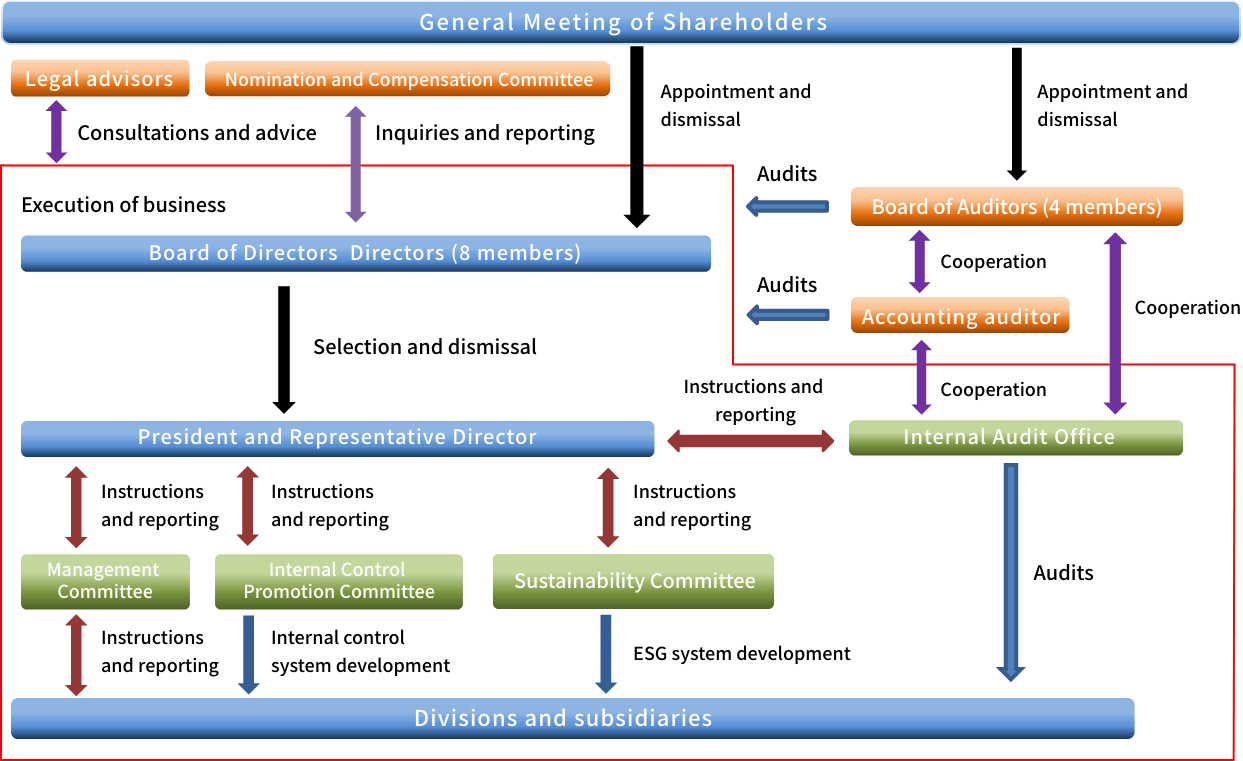
Note: The above-mentioned system related to corporate governance is described with reference to the details as of the date of submission (September 29, 2022).
2. The reasons for selecting the current corporate governance system
Our company adopted an audit system, and as a company, we established a system for holding general meetings of shareholders, the Board of Directors and the Audit & Supervisory Board, and for the position of accounting auditors as stipulated by the Companies Act.
As of the submission date of this document, the Board of Directors consists of eight Directors including three outside directors, and holds a regular meeting every month and extraordinary meetings whenever it is deemed necessary. The Board of Directors makes decisions on important items stipulated by laws, ordinances or articles of incorporation as well as on basic policies and plans for management, and makes reports related to monthly and annual financial results.
The company appoints and employs outside directors in order to improve the decision-making and supervisory functions of the management and increase transparency. The position of outside directors was established so that capable individuals with a wide range of knowledge and experience related to management would provide their opinions from an objective standpoint as specialists in management, and also supervise the business execution of directors.
As of the submission date of this document, the four auditors of the Audit & Supervisory Board are all outside ones so that objectivity and neutrality are ensured and they can supervise the status of the performance of duties. Also, the auditors attend management meetings and other important meetings in addition to the Board of Directors’ meetings, and while freely giving their opinions from their standpoint as auditors, they supervise the status of the performance of duties by directors. Accordingly, we consider that the Audit & Supervisory Board functions to a sufficient degree from the point of view of ensuring the effectiveness of business management.
Regarding business execution, we hold a management meeting in order to streamline decision-making and realize flexible management. The management meeting provides the management personnel (full-time directors, executive officers, general managers and division heads) with opportunities for discussion, and is held every week, in principle.
They deliberate on important items, including those proposed to the Board of Directors. Those other than the management personnel can also participate, when their participation are considered necessary.
Regarding the executive officer system, we aim to clarify responsibilities, improve the fairness and transparency of management, strengthen the functions of the Board of Directors and increase the speed as well as effectiveness of business by separating “decision-making and supervisory functions for important management matters” and “business execution function.”
Also, we have established an “internal control promotion committee” for the purposes of furthering the compliance with laws and regulations within the company, promoting the development of internal control systems and the development of a risk management system, and thoroughly enforcing corporate ethics.
We believe it is possible to realize appropriate corporate governance by combining the above management execution system with the management supervision function of auditors and the restraint function of the internal control system mentioned below. Therefore, we adopted the current system.
3. Basic policies for an internal control system
The main business operations of our company are the direct management of our restaurant chain and the operation of our franchise chain. For that reason, there are many laws that must be observed such as the Food Sanitation Act, and the danger of losses due to food poisoning or fire is conceivable. On the basis of these business characteristics, we have established an internal control system in order to grow healthily and sustainably, and consider the proper operation of the system to be an important issue for management.
4. Status of the establishment of an internal control system
At the Board of Directors’ meeting held on July 13, 2015, we set forth the basic policy for an internal control system as the basic policy for the establishment and operation of a system for proper business execution as follows.
Our company set forth the “regulations for compliance and risk management” in order to ensure that the execution of professional duties by directors and employees of our group companies is in conformity with the laws, regulations, and the articles of incorporation, and makes efforts toward the thorough application and enforcement thereof. Also, we ensure a system in which the execution of business is in conformity with the articles of incorporation, by always enabling directors and employees to browse the “regulations for compliance and risk management” based on their professional duties and decision-making authority in accordance with the regulations on the division of administrative responsibilities, the regulations on authority in professional duties, and the regulations on organizations.
Also, we inspect the appropriateness and effectiveness of our compliance and internal control systems, and make efforts to identify problematic points, and in order to formulate concrete countermeasures, the internal control promotion committee chaired by the President meets every two months, for the maintenance and implementation of overall internal control. And, in order for the company’s professional duties to be performed soundly in accordance with laws, regulations, and the articles of incorporation, audits are performed by auditors and internal audits on each department are conducted regularly by the internal audit office, which is under the direct control of the President.
Furthermore, we will establish and operate a whistle-blowing system as a means for employees to directly provide information regarding acts that are questionable under laws and regulations, and will strive for early detection and correction of improper acts.
5. Basic policies for the exclusion of anti-social forces and the status of establishment of systems
The “basic policy on sustainability” and “regulations for compliance and risk management” stipulate that we shall cut off any relationships with anti-social forces that threaten the order and safety of civil society. Our corporate group produced a “manual for the exclusion of anti-social forces such as organized crime groups and dealing with unreasonable demand,” with a provision for cutting off relations with anti-social forces, and developed a management system for the exclusion of anti-social forces as follows.
a. Establishment of a section and a committee for coping with anti-social forces
Our section for coping with anti-social forces shall be the general affairs planning department, and the head of the general affairs planning department shall be the responsible person, and efforts will be made to cut off the relationships with the anti-social forces. Also, the head of the general affairs planning department may nominate suitable personnel (from inside or outside the company) if necessary after obtaining the approval of the general manager of the management headquarters, to temporarily establish a committee against anti-social forces to cope with the anti-social forces.
b. Response to anti-social forces at restaurants
The person in charge of initial response at each restaurant shall be the restaurant manager (or the employee who is second in command if the manager is not at the restaurant). Also, based on the matters that require attention, the person in charge shall report the situation orally in accordance with the predetermined procedures, produce a “written report on response to anti-social forces such as organized crime groups” and create a document on the details of the response.
c. Status of cooperation with outside specialized agencies
We, mainly the general affairs planning department, cooperate closely with the police station having jurisdiction, the Prefectural Council for Expulsion of Violence, lawyers and others.
d. Investigation of business partners
For new business partners, we have set up a system to carry out an “investigation on anti-social forces” based on the “manual for new business partners.” For existing business partners, we conduct an “investigation on anti-social forces” once per year.